

Legacy Real Estate | November 24, 2026
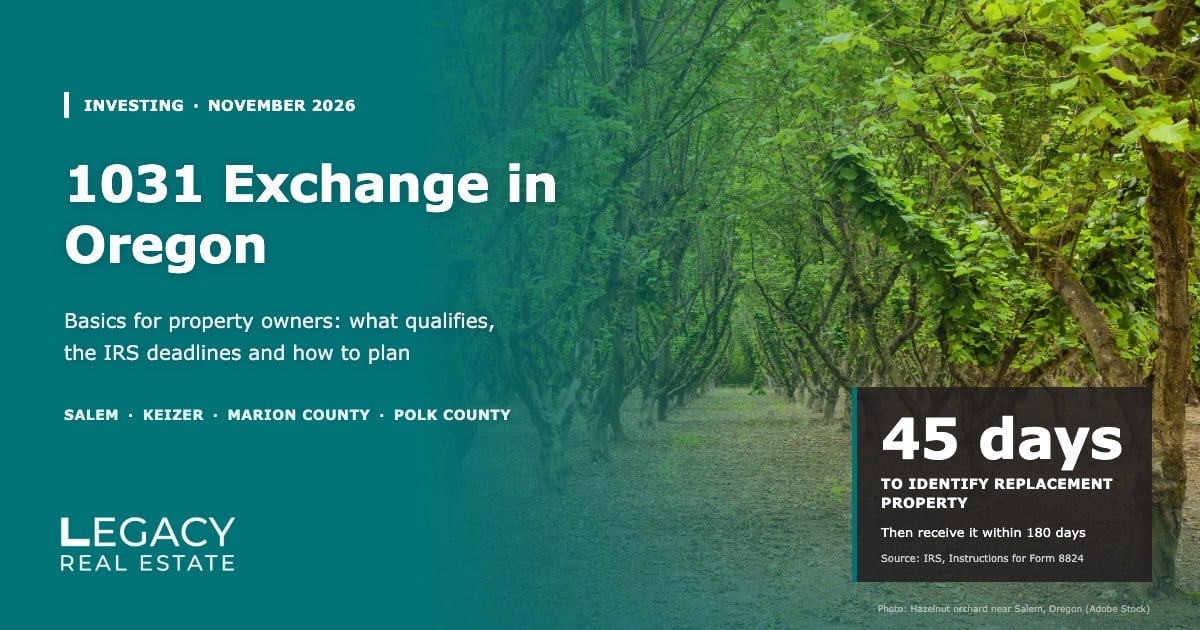
The short version: A 1031 exchange lets an owner of business or investment real estate sell one property and buy another of like kind while deferring tax on the gain. In Oregon, the process follows the federal rules in Section 1031 of the Internal Revenue Code. Two IRS deadlines drive everything: identify replacement property within 45 days and receive it within 180 days. Plan the exchange with a tax professional before you list.
If you own a rental house, a commercial building or a parcel of land in Salem, Keizer or elsewhere in Marion and Polk counties, a 1031 exchange is one of the first questions that comes up when you think about selling. This guide covers how a 1031 exchange works in Oregon, the deadlines that matter, and what to settle before you put a property on the market. It explains the process. It is not tax advice.
What is a 1031 exchange?
A 1031 exchange, also called a like-kind exchange, is named for Section 1031 of the Internal Revenue Code. According to the IRS, it applies to real property used for business or held as an investment that is exchanged solely for other business or investment property of the same type, or like kind. When the rules are met, gain or loss is generally not recognized at the time of the exchange. The tax is deferred, not erased.
Since January 1, 2018, the Tax Cuts and Jobs Act has limited Section 1031 to real property. Equipment, vehicles, artwork and other personal or intangible property no longer qualify, the IRS says.
What property qualifies for a 1031 exchange in Oregon?
The IRS describes like-kind real property broadly. Properties are like kind if they are of the same nature or character, even if they differ in grade or quality, and real properties are generally like kind whether improved or unimproved. In practice, an exchange can move from one type of investment real estate to another, for example from land to a commercial building.
A few limits matter for Oregon owners:
- Your home does not qualify. The IRS Instructions for Form 8824 state that Section 1031 does not apply if the property you gave up was used solely as your personal residence at the time of the exchange.
- Property held primarily for sale does not qualify. A lot or house bought to fix and resell quickly is treated differently from property held for investment.
- U.S. property is not like kind to foreign property. An Oregon property can be exchanged for property in another state, but not for property outside the United States.
- Partnership interests and stock are not real property for this purpose, under the IRS definition.
How do the 45-day and 180-day deadlines work?
Most exchanges today are deferred exchanges: you sell the property you are giving up first, then buy the replacement. The IRS sets two clocks that both start when you transfer the property you are giving up.
- 45 days to identify. Replacement property must be identified in writing within 45 days, in a signed document, with a clear description such as a legal description or street address.
- 180 days to receive. You must receive the replacement property within 180 days, or by the due date of your tax return for that year (including extensions), whichever is earlier.
These deadlines are firm, and the IRS instructions do not describe an extension for a slow escrow or a hard-to-find property. That is why the search for replacement property often starts before the first property is listed.
What does a qualified intermediary do?
In a deferred exchange, the sale proceeds are typically held by a qualified intermediary (QI) rather than paid to you. The Form 8824 instructions explain that an exchange using a QI is treated as a like-kind exchange when the requirements are met. They also note that your related parties and agents are “disqualified persons” who cannot serve as your QI.
Choose the QI, and have the exchange documents in place, before the sale closes. Your tax professional and attorney can advise on how that should be set up for your situation.
When is part of a 1031 exchange taxable?
If you receive money or other property that is not like kind along with the replacement property, the IRS says you must recognize gain to the extent of that money and other property. This is often called boot. A loss cannot be recognized in a like-kind exchange.
Exchanges with relatives or related businesses carry extra rules. The Form 8824 instructions say that if you or a related party disposes of the exchanged property within two years, the deferred gain is generally reported in the year of that disposition, with limited exceptions. Exchanges are reported to the IRS on Form 8824.
How should you plan a 1031 exchange in Salem?
Steps to take before you list
- Talk with your tax professional first. Confirm that an exchange fits your goals and how it would affect your federal and Oregon returns.
- Line up a qualified intermediary before closing, so the sale proceeds are not paid to you.
- Start looking at replacement property early. With 45 days to identify, it helps to know what is available in Salem, Keizer and the wider Mid-Willamette Valley.
- Match the timeline. Coordinate the sale closing and the replacement purchase with your broker, the escrow company and the QI.
- Keep records. Your tax professional will need the dates, closing statements and identification letter to complete Form 8824.
Questions to ask yourself
- Is the property I am selling held for investment or business use, not as my home or for quick resale?
- What type of property do I want next: land, a commercial building or another investment property?
- Am I buying from or selling to a relative or a business I am related to?
- Do I expect to receive any cash at closing?
A broker’s role is to help you price the property you are selling, find and evaluate replacement property within the deadlines, and keep both transactions on schedule. Questions about how the tax rules apply to you belong with a CPA or tax attorney.
Frequently asked questions
Can I do a 1031 exchange on my house in Oregon?
Not on a property used solely as your personal residence at the time of the exchange, according to the IRS Instructions for Form 8824. A separate home-sale exclusion may apply instead. Ask a tax professional about your situation.
Can I exchange land for a commercial building?
Generally yes. The IRS says real properties are generally like kind whether improved or unimproved, so land held for investment can be exchanged for other investment or business real property.
How long do I have to complete a 1031 exchange?
You must identify replacement property within 45 days of transferring the property you are giving up and receive it within 180 days, or by your tax return due date for that year if earlier.
Can I keep some of the cash from the sale?
You can, but the IRS says gain must be recognized to the extent of money or other property you receive that is not like kind.
Can I exchange Oregon property for property in another state?
Yes. Real property in the United States can be exchanged for other U.S. real property. Property outside the United States is not like kind to U.S. property.
Plan your next move with a local broker
A 1031 exchange works best when the sale and the purchase are planned together. Legacy Real Estate brokers have worked on investment, commercial and land transactions in the Mid-Willamette Valley since 2001. Contact a Legacy Real Estate broker to talk through your timeline, or meet the Legacy team first. You can also browse current listings on the Legacy Real Estate home search.
Sources
- IRS, Like-kind exchanges – Real estate tax tips
- IRS, 2026 Instructions for Form 8824, Like-Kind Exchanges
This article is general information, not tax, legal or financial advice. Consult a qualified tax professional about your situation. Legacy Real Estate is an independent brokerage in Salem, Oregon. Equal Housing Opportunity.